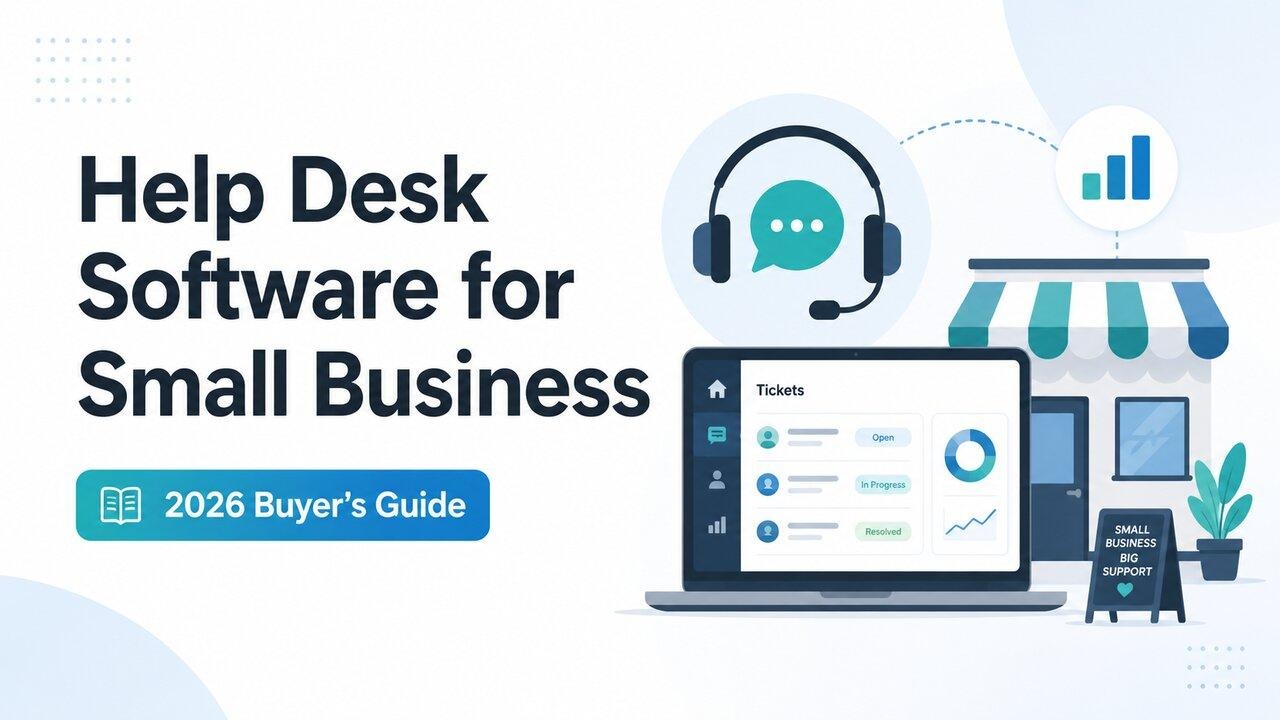
Every small business hits the same wall with support email. One day the shared inbox works. The next, two people answer the same customer with different information, a refund request sits unread for four days, and nobody can say how many complaints came in last month because nobody counted. The inbox didn’t get worse. The volume did.
Every small business hits the same wall with support email. One day the shared inbox works. The next, two people answer the same customer with different information, a refund request sits unread for four days, and nobody can say how many complaints came in last month because nobody counted. The inbox didn’t get worse. The volume did.
Help desk software fixes the specific failures of a shared inbox: every request becomes a ticket with an owner, a status, and a history, and you finally get numbers on response times. The stakes are higher than they feel. In PwC’s Future of Customer Experience survey, 32% of consumers said they would walk away from a brand they love after a single bad experience.
This guide covers when a small team actually needs a help desk, which features matter at that size (and which are enterprise noise), what a realistic budget looks like in 2026, and how to run a trial that settles the decision in a week. We set up trial accounts with seven vendors and connected a test Gmail inbox to each, so the observations below come from hands-on use, not feature pages.
When a shared inbox stops being enough
The threshold is lower than most owners expect: roughly two people handling a few dozen requests a week. Below that, Gmail plus discipline works. Above it, the failure modes are predictable and always the same. Two agents answer one customer with conflicting information because neither saw the other typing. A request gets mentally assigned to “someone” and sits for days. A customer replies to a three-week-old thread and their context is scattered across forwards nobody can find.
There’s also a quieter cost: no data. Without ticket statuses you can’t answer basic questions like “how long do we take to respond?” or “what do people complain about most?”, and without those answers you’re staffing and prioritizing on gut feel.
If you’ve apologized to a customer for a lost email more than once this quarter, you’ve crossed the line. The good news is that at small-business scale, moving to a help desk is an afternoon of work, not a project.
What actually matters at small-business scale
Enterprise buyers evaluate help desks on sandbox environments, skill-based routing, and audit logs. A team of two to twenty needs none of that. Six things matter:
A single inbox for every channel. Email is the base, but customers increasingly open conversations in website chat, Messenger, or SMS. What matters is that a conversation starting in one channel and continuing in another stays a single thread, with one owner.
Automation you’ll set up in minutes. Routing rules, auto-assignment, canned responses. Even three good rules save hours a week. If building a rule requires documentation, the tool failed this test.
AI that’s included, not an add-on. This is where 2026 pricing gets deceptive. AI reply drafting, ticket summaries, and self-service bots are now table stakes, but several major vendors sell them as per-agent add-ons that can double the bill. Always quote a tool with the AI you plan to use.
Integrations with the tools you run. Live chat, your ecommerce platform (Shopify above all), and a working API for everything else.
Transparent pricing. Published prices, a real trial, no surprise fees at renewal, and no seat-count cliffs that force a tier jump when you hire one more person.
Time to value. How long from signup to answering the first real ticket. For a small team this beats feature depth every time. Software that needs a consultant to configure is enterprise software, whatever the pricing page says.
What this looks like in practice
To make the criteria concrete, here’s how they play out in the tool that scored best on setup speed in our testing. HelpDesk is help desk software from Text, the company behind LiveChat and ChatBot, and its pitch to small teams is exactly the time-to-value argument above. It runs in the browser (with Mac and Windows apps), and in our test the path from signup to a connected email channel and a first automation rule took under an hour. No onboarding call, no implementation partner. Email, website chat, Messenger, and SMS all feed one inbox, and a conversation that starts in Messenger and continues over email stays a single thread.
The AI is what separates it at its price point. Every plan, including the cheapest, ships with an AI Agent that resolves routine questions in chat before they become tickets, plus an AI Copilot that drafts replies from your help center content. Ticket summaries and automatic tag suggestions keep the queue readable on the higher tier. Compare that with the add-on model common elsewhere: Freshdesk’s AI copilot costs $29 per agent per month extra, and Zendesk’s AI add-ons run around $50 per agent per month.
Pricing is two tiers plus Enterprise: Essential at $19 per user per month and Growth at $79 (billed annually; $25 and $99 month to month). Tickets are unlimited on every plan, the 14-day trial requires no credit card, and the team assists with migration from another help desk at no charge.
Two honest caveats, because no tool fits everyone. Essential keeps only 60 days of conversation history and includes 10 AI resolutions a month, so a team leaning on the AI Agent will want Growth. And there’s no ITSM layer: no asset management, no change workflows, nothing ITIL. An internal IT department with compliance-driven processes should look at dedicated service desk software instead. For customer-facing support at a small company, that’s the right trade: fewer modules to configure and a shorter road to a working queue.
What should you pay in 2026?
For the tiers small teams actually use, realistic pricing runs from $7 to about $55 per agent per month on annual billing. A five-person team should budget $95 to $275 a month before add-ons. Three patterns to watch:
The advertised seat price is rarely the real price. Zendesk’s Suite Team starts at $55 per agent, but its AI Copilot adds roughly $50 more; a five-person team on the Growth tier with Copilot lands near $8,300 a year. Freshdesk’s Growth plan is an attractive $19, but Freddy AI Copilot is a $29 add-on available only on the $55-and-up tiers. Tools that bundle AI into the seat price (HelpDesk at $19, Zoho Desk’s Zia on its Enterprise tier) often beat nominally cheaper seats once you do the full math.
Seat cliffs punish growth. Front caps its $25 Starter plan at 10 seats and a single channel, so seat eleven forces a jump to the $65 tier. Help Scout’s Standard-to-Plus threshold at 25 agents nearly doubles per-seat cost. Read the tier limits for the team you’ll have in a year, not the team you have today.
Free plans are extended trials, not destinations. Zoho Desk’s free tier covers three agents, Help Scout’s free plan caps at 100 customer contacts a month, and Spiceworks is free with ads for internal IT. All prove the workflow; growing teams typically hit the caps within a year.
Annual billing consistently saves 15 to 24% across vendors, but it locks in your seat count, so don’t over-provision.
Alternatives worth shortlisting
No single tool wins every scenario, and a fair guide says so. Depending on your channel mix and budget, these six deserve a look:
Help Scout ($25 to $45 per user/mo) is the pick for teams whose support is overwhelmingly email. The shared inbox behaves like Gmail with superpowers, and customers never see a ticket number. Its AI Answers bot bills separately at $0.75 per resolution, which makes costs harder to predict as volume grows.
Zoho Desk ($7 to $40 per agent/mo, free for 3 agents) is unbeatable on raw price and bundles its Zia AI into the seat cost. The trade-off is setup effort: the interface exposes a lot of configuration and rewards teams already living in the Zoho ecosystem.
Freshdesk ($19 to $89 per agent/mo) offers the widest feature set in the mid-range, including a 1,000+ app marketplace and SLA management. Budget the $29 AI add-on separately, and know the once-generous free tier is now a limited starter program.
Zendesk ($55 to $115 per agent/mo) is the platform you won’t outgrow: the deepest reporting and the biggest ecosystem, at the highest price and the heaviest admin burden. Pick it for where you’re going, not where you are.
Front ($25 to $105 per seat/mo) sits between an email client and a help desk, with the best collaboration feel of the group. The single-channel Starter cap means the realistic cost for most teams is the $65 tier.
Spiceworks Cloud Help Desk (free with ads, $6/agent Premium) answers a different question: internal IT tickets on zero budget. No multichannel inbox and no ecommerce integrations, so don’t stretch it into customer support.
| Tool | Starts at (annual, per user/mo) | Free plan | Trial | AI included in base price | Best for |
|---|---|---|---|---|---|
| HelpDesk | $19 | No | 14 days, no card | Yes (AI Agent + Copilot on all plans) | Fast setup, AI without add-ons |
| Help Scout | $25 | Yes, 100 contacts/mo | 15 days | No ($0.75/resolution) | Email-first teams |
| Zoho Desk | $7 | Yes, 3 agents | 15 days | Partly (full Zia on Enterprise) | Tightest budgets |
| Freshdesk | $19 | Limited starter program | 14 days | No (Copilot $29/agent add-on) | Feature breadth |
| Zendesk | $55 | No | 14 days | No (add-ons ~$50/agent) | Teams scaling past 50 agents |
| Front | $25 | No | 14 days | Mostly add-ons below Enterprise | Shared-inbox collaboration |
| Spiceworks | Free (ads) | Yes | n/a | No | Internal IT on zero budget |
Prices verified against official pricing pages in July 2026 and rounded to published annual rates. Vendors adjust packaging often, so confirm before you buy.
How to decide in one week
Start from your channel mix, not from feature lists. Email only? Help Scout or Front will feel natural. Email plus website chat, Messenger, or SMS? A multichannel tool like HelpDesk or Freshdesk consolidates that without extra modules. Internal IT requests only? Spiceworks, and you’re done.
Price the AI honestly. Quote every vendor at your team size with the AI features you plan to use. A $19 seat with AI included can cost less than a $15 seat with a $29 add-on. Then check the seat thresholds for next year’s headcount.
Trial two finalists with real tickets. Forward your actual support address, write your three most common canned responses, and build one routing rule. The tool your team still likes on day five is the answer. Every product above offers a trial long enough to run this test, and it beats any comparison table, including the one in this article.
FAQ
What is the best help desk software for a small business? It depends on your channels and budget, but the shortlist is short. HelpDesk offers the fastest setup with AI included from $19 per user, Help Scout suits email-only teams, Zoho Desk wins on price at $7 to $40 per agent, and Freshdesk gives the widest feature set in the mid-range. Zendesk fits small businesses that expect to scale quickly and can absorb the cost.
How much does help desk software cost for a small business? Realistic budgets run from $7 to about $55 per agent per month on annual billing for the tiers small teams actually use. A five-person team should expect $95 to $275 a month, plus AI add-ons where those are billed separately. Free plans exist but carry caps you’ll likely hit within months.
Do I need help desk software, or is a shared Gmail inbox enough? A shared inbox works until roughly two people and a few dozen requests a week. Past that, the failure modes are predictable: duplicate replies, dropped requests, and zero metrics. If you’ve apologized for a lost email more than once this quarter, you’ve crossed the line.
What’s the difference between a help desk and a service desk? A help desk manages customer or employee requests as tickets. A service desk, in the ITIL sense, adds structured IT processes: asset management, change management, and a configuration database. Small businesses doing customer support need a help desk; only IT departments with formal process requirements need a service desk.
Is there free help desk software worth using? Yes, within limits. Zoho Desk’s free plan covers three agents with basic ticketing, and Spiceworks Cloud Help Desk is free for internal IT if you accept ads. Treat free tiers as extended trials: they prove the workflow, but growing teams typically outgrow the caps within a year.

Comments 0
No comments yet. Start the conversation!